
Non-invasive prenatal testing (NIPT) has moved from a specialist, high-risk screening tool to a mainstream part of prenatal care. That transition has been driven by the success of cell-free DNA (cfDNA) analysis for the common fetal aneuploidies, but the future of NIPT will not be decided by sequencing alone.[1-3] The laboratories that succeed in this space will be the ones that can combine strong analytical performance with disciplined reporting, transparent counseling pathways, and scalable informatics that do not hide biological uncertainty behind a neat PDF.
In practice, the hardest part of NIPT is not generating a z-score. It is building a system that can tell a clinician what the result means for this patient, at this gestational age, with this fetal fraction, and with this pre-test probability. That is a much higher bar than simply calling a sample positive or negative.
The Missing Biological Context
The central strength of NIPT is also its central limitation: the assay uses placental cfDNA circulating in maternal plasma, not a direct fetal sample. That is why NIPT can be performed from a routine maternal blood draw, typically from 10 weeks onward. It is also why discordance exists. A cfDNA result may reflect the fetus, the placenta, maternal biology, or some combination of the three.
This biological reality shapes everything downstream. Fetal fraction remains the single most important sample-level quality metric. Borderline fetal fraction can reduce confidence, increase no-calls, and complicate interpretation of subtle chromosomal signals. High maternal body mass index, early gestational age, certain aneuploidies, and pre-analytical factors can all contribute to low fetal fraction. A laboratory that does not surface this clearly in the report is not simplifying the test for clinicians. It is obscuring the most important part of the result.
The same applies to no-call results. A failed or uninterpretable screen is not simply an empty box in the workflow. In real prenatal practice, a no-call may carry clinical meaning and should trigger review rather than passive repetition. Modern NIPT programs therefore need to treat no-calls, borderline signals, and unusual chromosomal patterns as part of the clinical product, not as exceptions outside it.
The Missing Interpretive Layer
One of the persistent misconceptions in prenatal screening is that a highly sensitive test automatically produces highly reliable positive calls. That is not how screening works. Sensitivity and specificity describe the assay. Positive predictive value (PPV) describes what a positive result means in the patient sitting in front of you.
That distinction matters enormously in NIPT. A positive trisomy 21 screen in a low-risk 25-year-old patient does not mean the same thing as a positive trisomy 21 screen in a 40-year-old patient with a concordant ultrasound finding. The instrument may be the same, the chemistry may be the same, and the analytical pipeline may be the same, but the post-test probability is not. Maternal age, prior obstetric history, gestational context, and ultrasound findings all move the interpretation.
This is why patient-specific reporting is becoming essential. A useful NIPT report should not stop at "screen positive." It should communicate the scope of the panel, the fetal fraction, the analytical limitations, and a patient-level interpretation that places the signal in context. That is particularly important for sex chromosome aneuploidies, rare autosomal trisomies, and microdeletions, where biological noise and lower prevalence can make naive interpretation misleading.
Professional guidance has moved in the same direction. cfDNA screening is now offered broadly rather than being reserved only for older or higher-risk pregnancies, but that broader access comes with a responsibility to counsel better, not less.[1] Wider adoption increases the number of low-prevalence situations in which false positives, no-calls, and discordant findings must be handled carefully. Expanding access without upgrading interpretation is not progress.
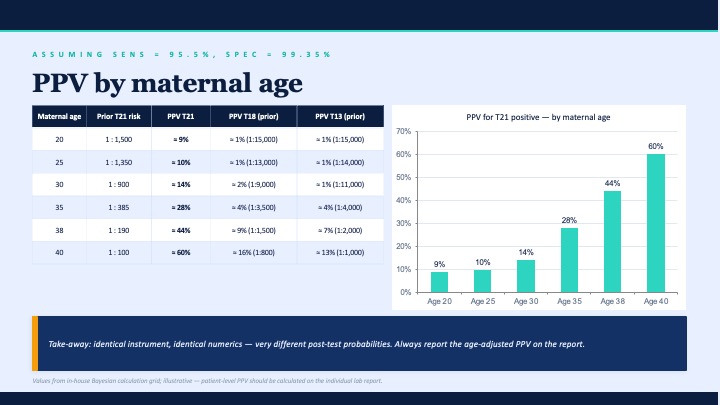
Figure 1. An excerpt illustrating how the same NIPT assay can yield very different positive predictive values depending on maternal age and pre-test probability.
NIPT as a clinical system
When people describe NIPT scaling, they often focus on throughput, automation, and turnaround time. Those metrics matter, but they are not enough. A scalable NIPT program has to function as a clinical system with several layers working together.
First, the analytical pipeline has to be validated with the right reference framework. That includes robust normalization, quality control thresholds, defined handling of low fetal fraction, and clear rules for when a result is reportable. For whole-genome shallow sequencing approaches, denoising and baseline stability are critical. Public reference sets are useful, but local and population-specific baselines can materially improve call stability when the program serves a distinct patient population.
Second, the workflow has to be explainable. Laboratories should be able to say why a result was called, why another was held, and what triggered a conservative comment or repeat recommendation. That is especially important when dealing with sex chromosome findings, mosaic patterns, vanishing twins, maternal copy-number variants, or multiple-chromosome abnormalities. If the workflow cannot support that conversation, then the pipeline is not mature enough for routine clinical use.
Third, reporting has to be structured for action. A good report makes it easy for the ordering clinician to see what was tested, what was not tested, how reliable the sample was, and what the next step should be. Positive core trisomy results, no-calls, expanded-panel findings, and unusual secondary signals should not all read the same way. Each requires different wording, different caution, and in many cases different follow-up.
Finally, informatics has to connect the laboratory to the clinic. The future is not just automated calling. It is automated, patient-specific interpretation, embedded PPV logic, cleaner report generation, and workflows that support counseling, confirmatory testing, and documentation without forcing clinicians to reconstruct the meaning of the result from raw laboratory language.
The Missing Stress-Test: Production Deployment vs Validation Data
The most useful NIPT lessons often come after the proof-of-concept phase. In our own program development work, the transition from validation to routine use made one point very clear: performance claims are easy to make in isolation and much harder to sustain in production.
That was one of the motivations behind building an in-house engine such as NIPTrix: a platform-agnostic workflow designed to support shallow whole-genome NIPT analysis with improved fetal-fraction handling, Y-chromosome calculation, denoising, and adaptive in-house baselines. The broader design logic is aligned with integrated pipelines such as NiPTUNE, which showed the value of combining fetal-fraction estimation, quality control, gender prediction, and aneuploidy calling in a single reproducible framework.[4] The value of that kind of architecture is not that it sounds modern. The value is that it turns a fragmented multi-tool workflow into a reproducible clinical pipeline with traceable outputs.
Early in-house experience showed us that once the workflow became stable, test volumes could rise rapidly without sacrificing turnaround. Program materials from the first in-house reporting phase showed approximately 900 reported tests between October 2025 and May 2026, with average turnaround around 3 days, near-complete turnaround-time compliance, and a relatively low failed or repeat rate. Those numbers are useful not as marketing claims, but as evidence that automation only becomes meaningful when it survives real clinical volume.
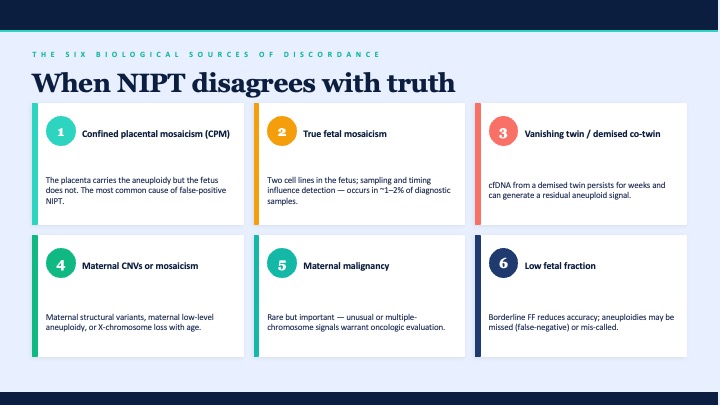
Figure 2. When NIPT doesn't agree with the truth.
Just as important were the edge cases. Borderline low-fetal-fraction samples, discordant sex chromosome calls, unusual autosomal signals, and microdeletion alerts forced the program to answer a harder question: when should a laboratory report conservatively rather than suppress uncertainty? In prenatal screening, conservative transparency is usually the better choice. A well-explained abnormal or borderline finding followed by confirmatory testing is preferable to over-reassurance built on aggressive filtering.
That is where scalable NIPT differs from a send-out mentality. A mature local program does not merely ship a result. It develops a reporting culture, a review process, and a clinical dialogue around what the assay can and cannot resolve.
The Missing Regional Lens
Another reason NIPT cannot be treated as a one-size-fits-all product is that prenatal genetics is shaped by population context. In the UAE and across parts of the GCC, higher rates of consanguinity and founder effects increase the burden of inherited disease.[5] That does not reduce the value of NIPT, but it does change how NIPT should be positioned.
NIPT is strongest as a screen for common fetal aneuploidies. It does not replace carrier screening for recessive disease, detailed fetal ultrasound, or diagnostic testing when the clinical question extends beyond the assay's validated scope. In populations with a higher background burden of recessive disorders and structural anomalies, that distinction matters even more. A sophisticated prenatal program needs to integrate NIPT with other reproductive genetics services rather than present it as a standalone answer to all prenatal risk.
Regional context also reinforces the value of local baselines and locally accountable interpretation. Population-specific data can improve stability in borderline calls, and local clinical teams are better placed to build workflows around counseling capacity, maternal-fetal medicine referral patterns, and confirmatory testing access.
The Missing Discipline: Expanding Panel Scope Without Diluting Trust
The field is already moving beyond the original core trisomy model. Expanded sex chromosome analysis, rare autosomal trisomies, microdeletions, and eventually more targeted single-gene applications are pushing NIPT into a broader screening role. At the same time, machine learning and adaptive baselining are making low-depth signal interpretation more stable, particularly in difficult samples.
But broader panels do not automatically create better care. Expanded scope increases the need for precise pre-test counseling, tighter validation standards, and careful language around PPV and residual risk. Core trisomy screening has relatively mature evidence. Expanded panels do not all sit on the same evidence base, and laboratories should not present them as though they do.
This is where the next generation of NIPT programs will differentiate themselves. The strongest programs will likely have:
- automated, patient-specific PPV reporting rather than generic positivity statements
- more reliable handling of low fetal fraction and borderline samples
- clearer pathways for unusual or multiple-chromosome findings
- structured workflows for confirmatory testing and documentation
- better integration between laboratory reporting, ultrasound findings, and genetic counseling
- disciplined limits around what should and should not be offered as routine screening
In other words, the future of NIPT is not simply "more AI" or "more targets." It is more clinical maturity.
Conclusion
NIPT has already changed prenatal screening by making high-performance cfDNA analysis widely accessible. The next phase of progress will come from turning that analytical power into a more trustworthy clinical system. That means explainable pipelines, patient-specific interpretation, conservative handling of uncertainty, and workflows that support confirmatory testing rather than blur the distinction between screening and diagnosis.
The laboratories that lead this next phase will not be the ones with the longest panel or the loudest software claims. They will be the ones that understand a simple point: in prenatal screening, credibility scales only when interpretation does.
References
- American College of Obstetricians and Gynecologists. Screening for Fetal Chromosomal Abnormalities. Practice Advisory. January 2026. Available at: https://www.acog.org/clinical/clinical-guidance/practice-advisory/articles/2026/01/screening-for-fetal-chromosomal-abnormalities
- Norton ME, Jacobsson B, Swamy GK, et al. Cell-free DNA analysis for noninvasive examination of trisomy. N Engl J Med. 2015;372(17):1589-1597. doi:10.1056/NEJMoa1407349
- Gil MM, Quezada MS, Revello R, Akolekar R, Nicolaides KH. Analysis of cell-free DNA in maternal blood in screening for fetal aneuploidies: updated meta-analysis. Ultrasound Obstet Gynecol. 2017;50(3):302-314. doi:10.1002/uog.17484
- Duboc G, Limou S, Le Bouar G, et al. NiPTUNE: an automated pipeline for noninvasive prenatal testing in an accurate, integrative and flexible framework. Brief Bioinform. 2022;23(1):bbab380. doi:10.1093/bib/bbab380
- Adam H, Ghenimi N, ElKhalil R, et al. Epidemiology of congenital anomalies in the Gulf Cooperation Council countries: a scoping review. BMJ Open. 2025;15(4):e093825. doi:10.1136/bmjopen-2024-093825